


Cross-Contamination in Shared Indoor Spaces: Why Cleaning Alone Leaves a Gap
Hospitals, medical and dental offices, clinics, waiting rooms, offices, schools, gyms and other shared indoor environments face a continuous challenge: cross-contamination in shared spaces.
A room may be thoroughly cleaned and disinfected in the morning, but as soon as people return, the indoor environment begins to change again. People breathe, cough and sneeze. Doors open and close. Frequently touched surfaces are used again. Air circulates between people and throughout the room.
Cleaning and disinfection remain essential. But they are periodic activities, while the reintroduction of microorganisms and other contaminants can happen continuously.
Cleaning is periodic. Cross-contamination is continuous.
That is the gap continuous air and surface sanitization is designed to address.
What Is Cross-Contamination in an Indoor Environment? 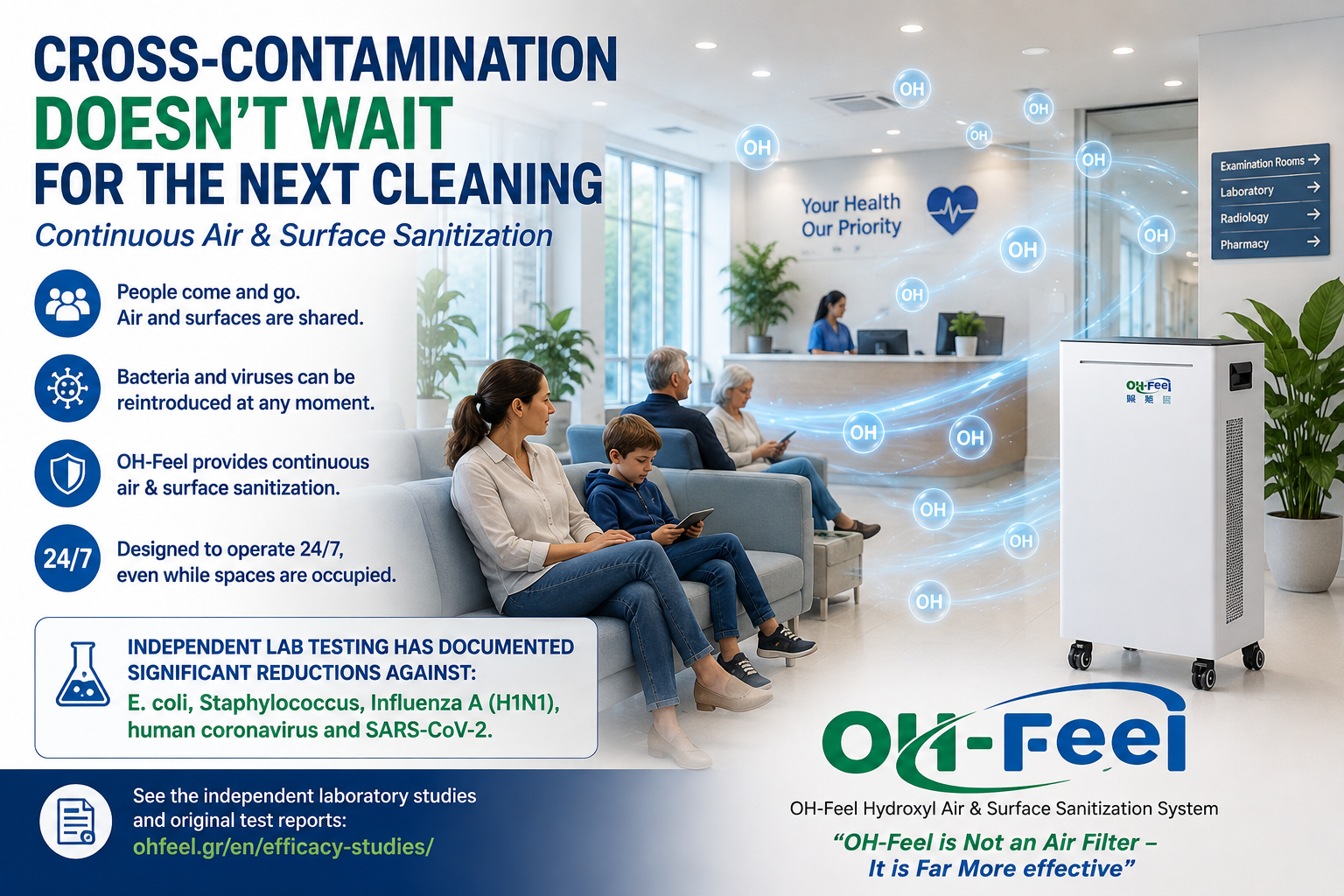
Cross-contamination is the transfer of contaminants from one person, object, surface or area to another.
In a busy indoor environment, there are numerous opportunities for this to occur. People enter carrying microorganisms and particles from outside. Hands touch door handles, chairs, desks and shared equipment. Respiratory particles are released into the surrounding air. Air movement can redistribute airborne material throughout a room.
The challenge becomes particularly important in environments with frequent turnover or many occupants, including:
- Hospitals and clinics
- Medical and dental offices
- Waiting rooms
- Nursing and care facilities
- Offices and meeting rooms
- Schools and classrooms
- Gyms and fitness facilities
- Hotels and hospitality environments
- Other busy shared indoor spaces
The issue isn’t that conventional cleaning doesn’t work. It is that a cleaned environment does not remain unchanged once it is occupied again.
Why Cleaning and Disinfection Are Only Part of the Solution
Routine cleaning and surface disinfection are fundamental to good environmental hygiene.
Ventilation is also important because it replaces or dilutes indoor air, while appropriately selected filtration can capture particles carried through the filtration system.
Each performs an important function.
The limitation is time and reach.
A surface disinfectant works when and where it is applied. Cleaning removes contamination present during the cleaning process. A filter treats air that actually passes through the filtration device.
Meanwhile, the occupied environment continues to change.
This creates an opportunity for a complementary approach: continuous treatment that operates between routine cleaning and disinfection cycles.
Air and Surfaces Are Part of the Same Indoor Environment
Indoor air quality is sometimes treated as though the air and surfaces in a room are completely separate problems.
In reality, they continually interact.
Particles can settle from the air onto surfaces. Activity can disturb settled material. People touch surfaces and subsequently touch other objects. Air currents generated by ventilation, air conditioning, movement and open doors continually circulate material throughout occupied spaces.
This is particularly relevant in healthcare and other high-occupancy environments.
An environmental strategy therefore benefits from considering both the air people breathe and the exposed surfaces surrounding them.
This is one of the important differences between conventional filtration and OH-Feel hydroxyl technology.
Continuous Hydroxyl Air & Surface Sanitization
OH-Feel systems generate hydroxyl radicals (•OH), highly reactive molecules that also occur naturally in atmospheric chemistry.
Rather than relying exclusively on contaminants being drawn into a machine, the hydroxyls generated by OH-Feel disperse into the surrounding indoor environment.
There, they react with susceptible contaminants in the air and on exposed surfaces.
This allows OH-Feel to provide continuous air and surface treatment while the indoor space remains occupied.
The objective is not to replace existing hygiene practices. It is to add an additional layer that continues working between those periodic interventions.
What Has OH-Feel Actually Been Tested Against?
Claims about sanitization should be supported by evidence.
OH-Feel systems have undergone independent laboratory evaluation against a range of biological and environmental contaminants. Original laboratory reports and readable summaries are available through the OH-Feel website so that healthcare professionals, facility managers and customers can examine the underlying evidence and test methodologies themselves.
Testing includes bacteria and viruses as well as mold, particulate matter and chemical pollutants. Among the microorganisms evaluated in OH-Feel’s test programme are human coronavirus HCoV-229E and bacteria including Staphylococcus. The broader efficacy library contains the individual reports and conditions for the different OH-Feel models.
Hospital/Medical Testing of the OH500F08
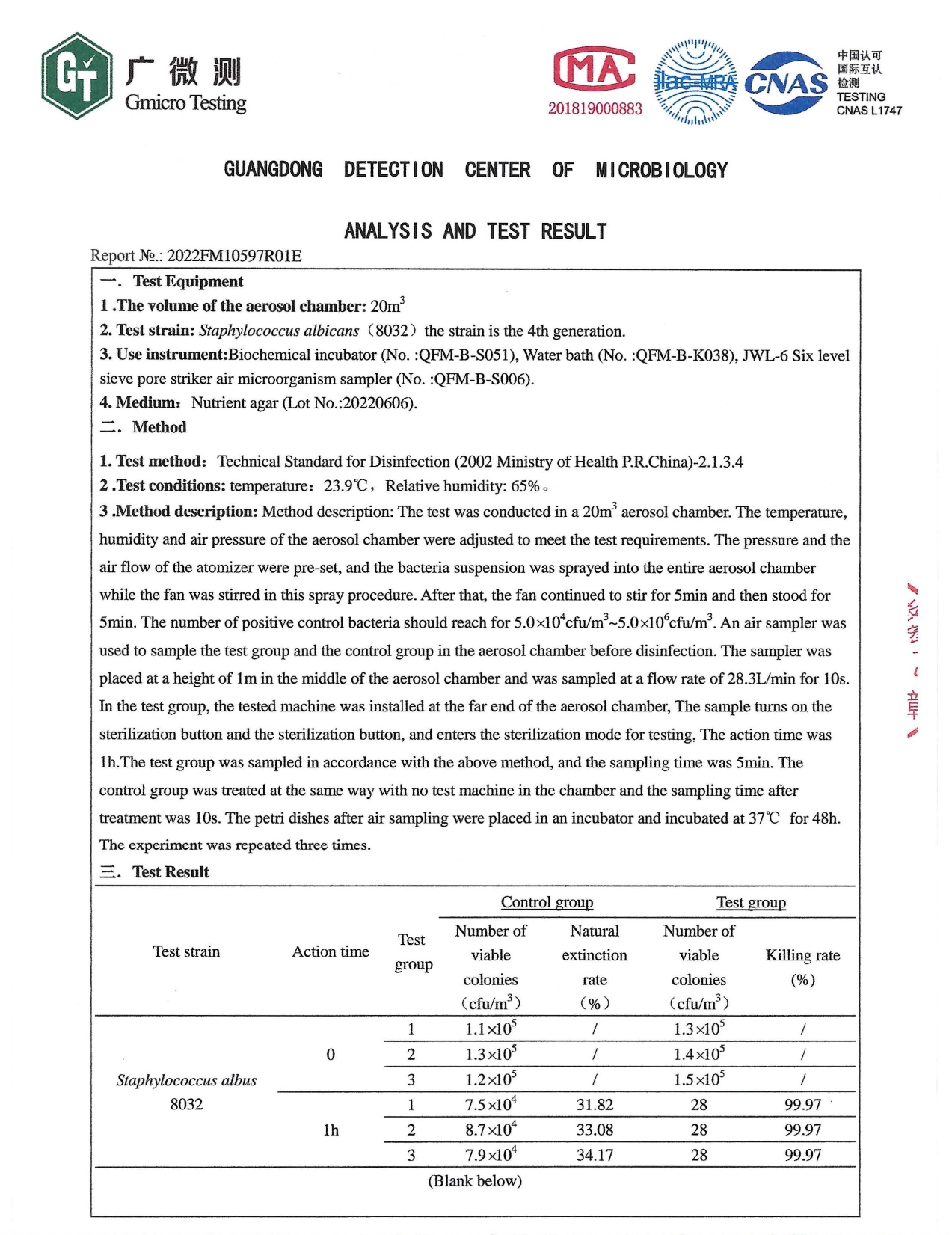
Of particular relevance to healthcare environments is the independent evaluation of the OH-Feel OH500F08 by the Guangdong Detection Center of Microbiology, a CNAS-accredited laboratory.
The device underwent a series of medical-grade evaluations covering airborne microorganisms as well as operating and safety characteristics.
In a 40 m³ test chamber, testing of natural airborne bacteria was conducted for 60 minutes and repeated three times. The recorded reduction rates were:
92.38%
91.15%
92.94%
In a separate controlled 20 m³ aerosol chamber test, the OH500F08 was tested against Staphylococcus albus for 60 minutes, with the experiment repeated three times.
The recorded killing rate was 99.97% in all three tests.
These percentages relate specifically to the defined laboratory conditions, organisms, model and exposure periods described in the original test report. They should not be interpreted as identical performance in every real-world environment.
That distinction is important — but so is the result.
This is measurable independent evidence of substantial microbial reduction, rather than a general claim that hydroxyl technology simply “kills germs.”
What About Viruses?
OH-Feel’s independent testing programme also includes viral testing.
For example, the OH-Feel CZ02 underwent independent airborne human coronavirus HCoV-229E testing at the Guangdong Detection Center of Microbiology. The original reports and summaries are available in the OH-Feel efficacy library.
Other testing within the OH-Feel validation programme covers additional viruses and microorganisms under specified laboratory conditions.
This is why we believe it is important to distinguish between two very different statements:
OH-Feel has demonstrated significant reductions of tested microorganisms under controlled conditions.
That is supported by laboratory evidence.
It would be different to claim that an environmental sanitization system guarantees prevention of infection or disease transmission. It does not.
The purpose of OH-Feel is to reduce environmental contamination, adding another layer to established cleaning, hygiene, ventilation and infection-control practices.
Why Continuous Operation Matters
Consider a medical waiting room.
The room is cleaned before opening.
Then the first patients arrive.
Over the next several hours, dozens of people may enter and leave. Chairs are occupied repeatedly. Doors are opened. Reception surfaces are touched. People talk, breathe, cough or sneeze. Staff move between different areas.
The environment at 2:00 p.m. is no longer the environment that existed immediately after the morning cleaning.
The same principle applies to a dental office, workplace, classroom, gym or other busy shared space.
This is where continuous treatment becomes particularly relevant.
OH-Feel systems are designed for extended operation in occupied environments rather than short treatment periods followed by shutdown.
Instead of waiting for the next cleaning cycle, treatment continues while the room is being used.
Healthcare Applications
Healthcare environments deserve particular attention because controlling environmental microbial contamination is an important part of overall hygiene and infection-control strategies.
Potential OH-Feel applications include:
Hospitals
Patient areas, waiting areas and other appropriate occupied indoor environments.
Medical Clinics
Continuous environmental treatment during normal operating hours.
Dental Offices
Treatment of shared air and exposed surfaces in waiting and treatment environments.
Waiting Rooms
Areas with frequent turnover and repeated occupancy throughout the day.
Care Facilities
Shared indoor environments occupied for extended periods.
The appropriate OH-Feel model and placement depend on factors including room size, layout, occupancy and the intended application.
Offices, Schools, Gyms and Other Shared Spaces
Cross-contamination isn’t exclusively a healthcare issue.
An office meeting room may be used by several groups during a single day. A classroom can contain dozens of students for hours. Gym equipment and changing areas experience continual turnover. Hotels and hospitality businesses receive a constantly changing population.
These environments share the same basic problem:
Cleaning occurs at intervals. Occupancy occurs between those intervals.
Continuous environmental treatment provides an additional approach for that period in between.
Safety Matters Just as Much as Efficacy
A system designed for continuous use in occupied environments needs evidence addressing not only efficacy, but safety.
OH-Feel therefore provides its safety and compliance documentation alongside its efficacy studies.
For example, independent testing of the OH500F08 at the Guangdong Detection Center of Microbiology included ozone and UV-leakage measurements. The testing reported approximately 3 ppb average ozone concentration under the specified test conditions and 0 µW/cm² UV leakage at the measured perimeter, alongside its microbial-performance testing.
Separate testing by the Atmospheric Chemistry Laboratory at Greece’s NCSR “Demokritos” evaluated ozone emissions from the 500 Series during extended operation in a sealed 18 m² indoor space. The reported maximum concentration was 30.5 ppb, compared with an initial 9.7 ppb. The complete safety and certification documentation is available for review on the OH-Feel website.
This combination matters.
Effectiveness without appropriate safety isn’t enough for an occupied-space technology.
Not a Replacement — An Additional Layer
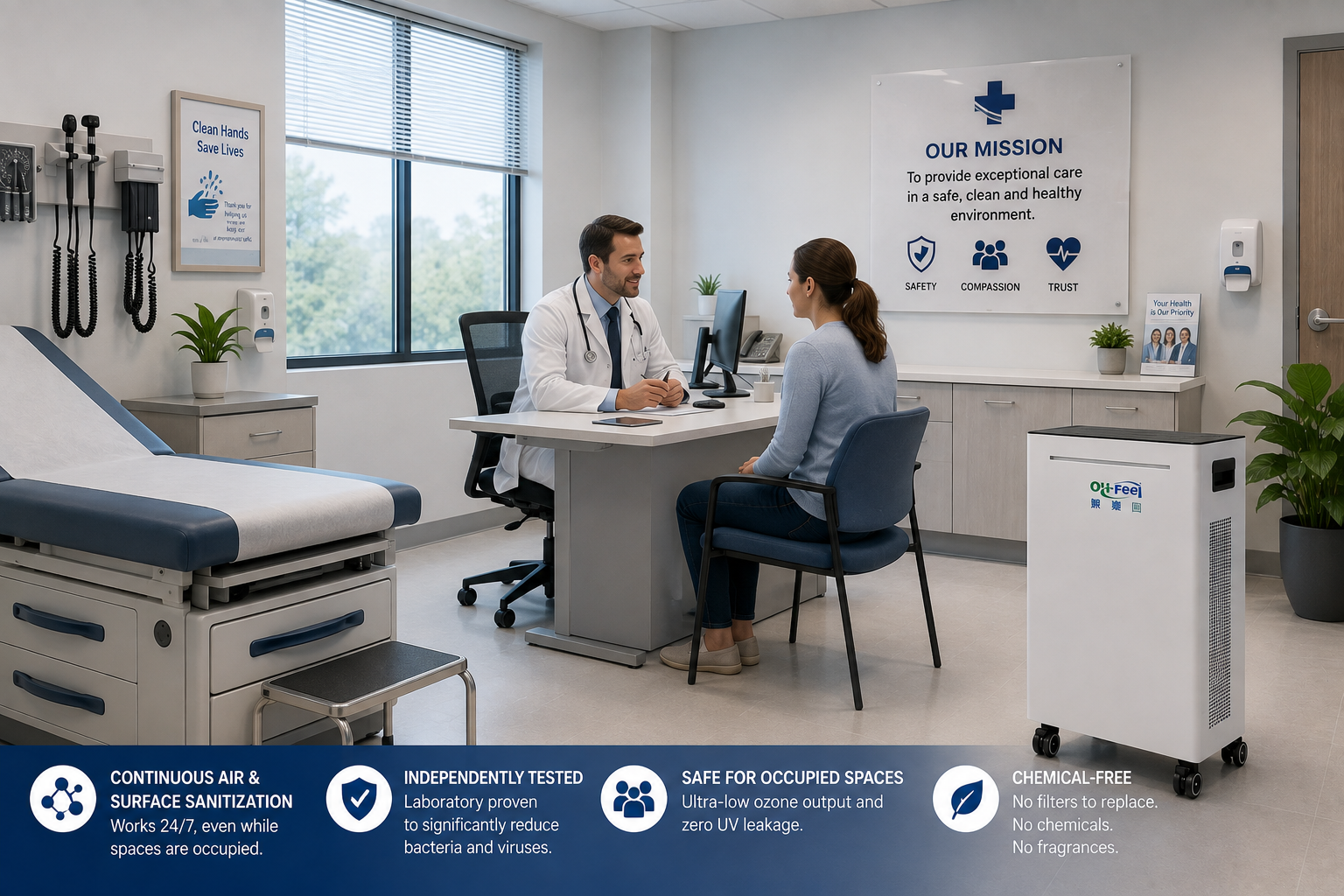
OH-Feel should not be viewed as a reason to stop cleaning surfaces, reduce ventilation, abandon appropriate filtration or disregard established infection-control procedures.
Those measures serve different purposes.
Instead, hydroxyl technology provides another layer:
Cleaning removes contamination at scheduled intervals.
Surface disinfection targets specific surfaces when applied.
Ventilation exchanges or dilutes indoor air.
Filtration captures particles from air passing through the filter.
OH-Feel hydroxyl technology provides continuous treatment throughout the occupied indoor environment, including the surrounding air and exposed surfaces.
The technologies are therefore complementary rather than mutually exclusive.
Independent Evidence You Can Examine Yourself
One principle has guided the development of the OH-Feel website:
You shouldn’t have to take our word for it.
OH-Feel provides access to its independent laboratory documentation, including original reports rather than simply displaying marketing claims or isolated percentages.
The online validation library covers efficacy testing involving bacteria, viruses, mold, VOCs and particulate matter, together with ozone, electrical safety, electromagnetic compatibility and other safety and compliance testing.
For healthcare professionals, facility managers, engineers and other decision-makers, the methodology and test conditions matter just as much as the headline result.
View the OH-Feel Independent Efficacy Studies
View OH-Feel Safety & Certifications
Continuous Environments Need Continuous Thinking
No indoor environment remains static after it has been cleaned.
People return. Air circulates. Surfaces are touched. New contaminants are introduced.
That doesn’t diminish the importance of cleaning and disinfection. It demonstrates why environmental hygiene cannot be thought of only as something that happens once or twice a day.
OH-Feel hydroxyl technology provides a continuous additional layer of air and surface sanitization designed for occupied indoor environments, backed by independent testing that customers and professionals can review for themselves.
Cleaning is periodic.
Cross-contamination is continuous.
Protection should be continuous too.
For hospitals, clinics, medical and dental offices, workplaces, schools, gyms and other shared environments, contact OH-Feel Greece to discuss the appropriate system for your space.
