


Hydroxyl Air Purifier vs HEPA Filters, Ionizers & Ozone Generators
Hydroxyl Air Purifier vs Traditional Air Purifiers
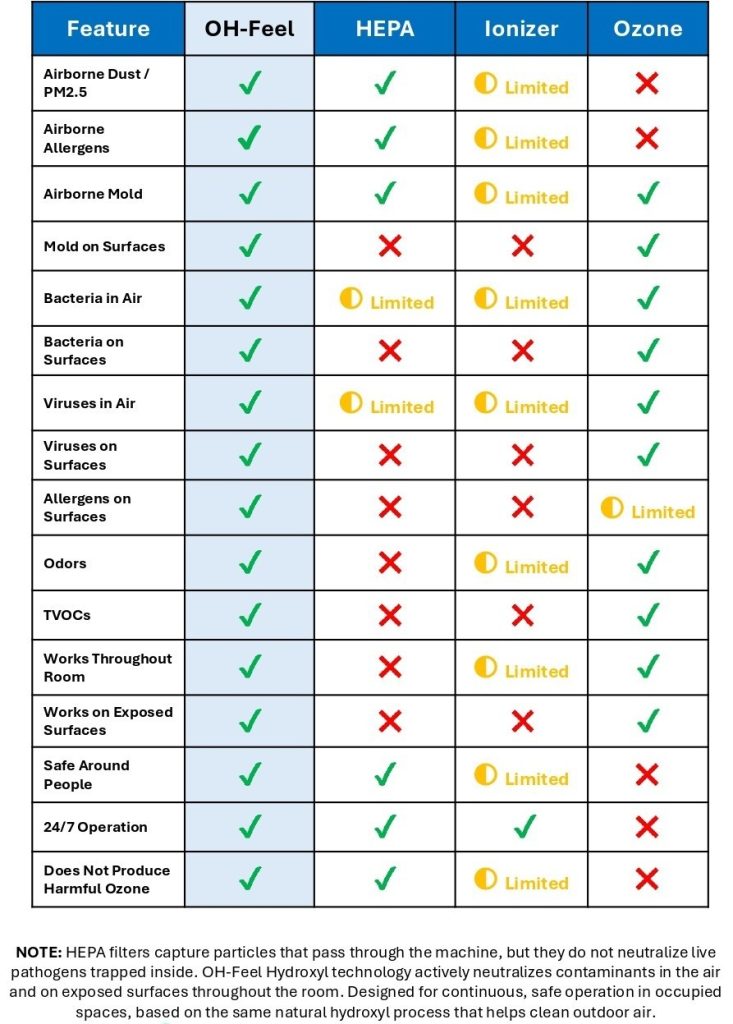
Hydroxyl air purifiers work very differently from traditional HEPA filters, ionizers, ozone generators, UV-C devices, and PCO systems. Instead of only cleaning the air that passes through the device, hydroxyl technology continuously generates hydroxyl radicals that disperse throughout the indoor environment, helping to neutralize odors, VOCs, bacteria, mold, viruses, and other contaminants in the air and on exposed surfaces. Understanding these differences is essential when choosing the most effective air purification technology for your home, office, healthcare facility, hotel, restaurant, or boat.
Traditional filter-based air purifiers (including HEPA, electrostatic, UV-C, and PCO systems) share the same fundamental limitation: they primarily treat the air that passes directly through the device and do not actively clean the entire room, exposed surfaces, persistent odors, or many gaseous pollutants.
- Filter-based technologies typically achieve their maximum whole-room pollution reduction (around 50%, according to Novoselac & Siegel, 2009) only after extended operation.
- Air leaving the filter immediately mixes with untreated room air, reducing overall effectiveness.
- Air stratification, circulation patterns, and the continuous introduction of new air mean much of the room’s air may never pass through the filter.
- Most filters capture particles but do not effectively remove persistent odors, gaseous pollutants (TVOCs), or many airborne chemicals.
- Because filters do not generate a hydroxyl cascade, they do not actively neutralize contaminants on exposed surfaces throughout the room.
Even larger air purifiers with more powerful fans can process greater volumes of air, but they still rely on contaminants passing through the unit before treatment can occur. This fundamental limitation prevents them from continuously treating the entire indoor environment in the way hydroxyl technology is designed to do.
Compare Air Cleaning Technologies
Disadvantages of Other Technologies
HEPA Filters
What is it?
A HEPA (High-Efficiency Particulate Air) filter is designed to capture airborne particles above a specified size as air passes through the filter. HEPA filters can be highly effective at reducing airborne dust, pollen and other particulates that physically pass through the unit.
Disadvantages
Like all filter-based air cleaning technologies, HEPA systems only treat the air that passes directly through the filter. They do not actively clean the entire room, exposed surfaces, odors, or many gaseous pollutants.
- Whole-room pollution reduction is limited because only a portion of the room’s air passes through the filter at any given time.
- Air leaving the filter immediately mixes with untreated room air, reducing overall effectiveness.
- Air stratification, circulation patterns and incoming fresh air mean much of the room’s air may never pass through the filter.
- HEPA filters capture particles but do not effectively remove odors, gaseous pollutants (TVOCs), or many airborne chemicals.
- HEPA filters do not actively neutralize contaminants on exposed surfaces throughout the room.
- Captured contaminants remain inside the filter and require ongoing maintenance and filter replacement.
- Larger and more powerful systems may process more air, but they cannot overcome the fundamental limitation of only treating air that passes through the device.
PCO PHTOTOCATALYTIC OXIDATION
What is it?
Some manufacturers have developed air-cleaning devices based on Photocatalytic Oxidation (PCO) or PECO technology. These systems generate hydroxyl radicals or other oxidants inside the device to react with contaminants that pass through the unit.
Disadvantages
While such PCO / PECO / Photocatalytic devices create hydroxyl radicals within the device, those hydroxyls are so short-lived (typically < 0.2 seconds) that their effect does not generally extend far outside the device.
Consequently, these systems still depend primarily on contaminants passing through the unit and therefore share many of the same limitations as traditional filter-based technologies:
• Only the air passing through the device is actively treated.
• Air leaving the device immediately mixes with untreated room air.
• Effectiveness decreases rapidly with distance from the device.
• PCO systems do not effectively treat exposed surfaces throughout a room.
• Odors, airborne contaminants and pollutants located away from the device may remain unaffected.
Many marketing claims for basic PCO technology imply that sufficient hydroxyls spread throughout a room to effectively clean the air and surfaces. Independent research suggests that the effects are generally concentrated near the device itself.
IONIZATION
What is it?
Ionizer air purifiers release ions (charged particles) into the air. These ions attach to airborne particles such as dust, smoke and other contaminants, causing them to become electrically charged. The charged particles may then settle onto surfaces or be attracted to nearby objects, removing some of them from the air.
Under certain conditions and over extended periods, high concentrations of ions have been shown to reduce the viability of some microorganisms.
However, the practical limitations of ionization technology are often overlooked.
Disadvantages
• Like HEPA filters, ionizers primarily affect airborne particles and have little effect on gaseous pollutants such as odors, smoke compounds, VOCs and chemical fumes.
• Ion concentrations decrease rapidly with distance from the device, making it difficult to maintain effective levels throughout an entire room.
• Any effect tends to be localized near the machine rather than throughout the entire space.
• Particles that settle onto surfaces can easily become airborne again through normal activity, cleaning or air movement.
• Ionization often transfers contaminants from the air onto walls, furniture, fabrics and other surfaces. Unless these contaminants are physically removed through cleaning or neutralized, they may be reintroduced into the air when disturbed.
• Even when particles are removed from the air, they are not necessarily neutralized and may remain present on surrounding surfaces.
• Some ionization technologies may generate ozone as a by-product. Elevated ozone levels can irritate the respiratory system and may not be suitable for occupied spaces.
• Marketing claims often suggest whole-room air and surface sanitization, but ionization systems generally do not provide consistent room-wide treatment of air and exposed surfaces.
For these reasons, ionizers are generally better described as particle-management devices rather than comprehensive air and surface sanitization systems.
GERMICIDAL UV IN-DUCT
Germicidal UV in Duct
What is it?
Germicidal UV In-Duct systems use UV-C lamps installed inside HVAC ductwork. UV-C light can damage the DNA or RNA of microorganisms, reducing their ability to reproduce and infect.
Disadvantages
• UV-C treatment occurs only inside the HVAC ductwork and only affects contaminants that pass sufficiently close to the lamp.
• Airborne contaminants located elsewhere in the room are not treated until they eventually pass through the HVAC system.
• UV-C systems do not provide continuous room-wide air treatment and do not create an active cleaning effect throughout the occupied space.
• Exposed surfaces, furniture, fabrics, walls and other room contents are generally not treated.
• UV-C systems do not remove odors, VOCs, smoke compounds or other gaseous pollutants.
• Dust accumulation on lamps can reduce effectiveness and requires periodic maintenance.
• Installation costs, electrical requirements and lamp replacement costs can be significant.
• Improper installation or exposure to UV-C light may present safety concerns.
While Germicidal UV can be effective as a supplemental HVAC technology, it does not provide comprehensive air and surface sanitization throughout an occupied room.
FOGGERS
What is it?
A fogger is a device that disperses a disinfectant mist or chemical fog throughout a room to reduce bacteria, viruses, mould and other contaminants.
Such chemical ‘fogs’ are dangerous to humans, and so foggers are used to fumigate spaces without people being present. While the process itself may be effective (for a short period), it has many obvious drawbacks compared to a technology which can achieve better results, but safely run 24/7 with people present.
Disadvantages
One major disadvantage is that treatment only occurs during the fumigation process. As soon as people re-enter the room, new contaminants are continuously introduced into the environment.
Other drawbacks of using a ‘fogger’ as an anti-microbial device:
- Requires trained personnel working strictly in accordance with a safe method of work statement.
- Provides no ongoing protection between treatments. Once fumigation is complete, contaminants can immediately begin accumulating again.
- Requires the room or space to be treated to be empty of people and secured so that people, pets etc. cannot accidentally enter the space being fumigated.
- Requires items likely to be damaged by the fumigant to be removed, and later replaced, to protect them from damage.
- Requires the transportation, storage or handling of toxic chemicals
Unlike fogging systems, OH-Feel technology is designed for continuous operation in occupied spaces, providing ongoing air and surface treatment rather than periodic fumigation.