

Odors You Don’t Notice Anymore — But Other People Do
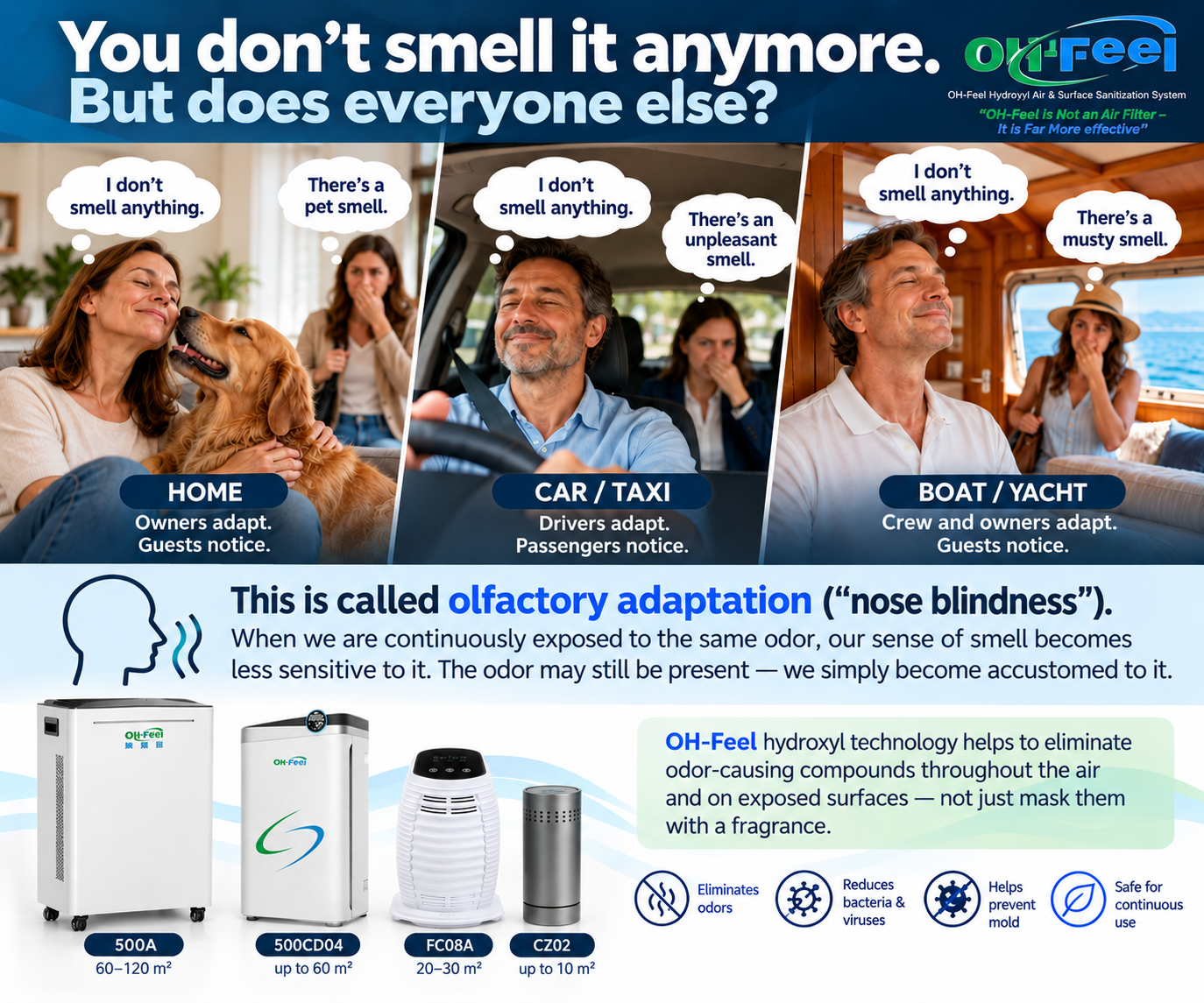
Have you ever walked into someone’s home, stepped into a car or taxi, or entered a boat cabin and immediately noticed an unpleasant odor — while the person who spends every day there doesn’t seem to notice anything?
There is a reason for this.
It is called olfactory adaptation, sometimes referred to as “nose blindness.”
When we are continuously exposed to the same smell, our sense of smell gradually becomes less sensitive to it. The odor has not necessarily disappeared. Instead, our brain and olfactory system have become accustomed to its constant presence.
This creates an interesting problem: the person most familiar with a space may actually be one of the least reliable people to judge how that space smells to someone entering it for the first time.
What is olfactory adaptation?
Our sense of smell is particularly sensitive to changes in our environment. When a new odor appears, we tend to notice it quickly.
But if that odor remains present, our perception of it can gradually diminish.
Think about putting on perfume or cologne in the morning. You may notice it strongly at first but barely detect it later in the day, even though someone standing near you still can.
The same principle applies to unpleasant odors.
Someone living with pets may stop noticing the characteristic smell of the home. A smoker may become accustomed to tobacco odors. Someone living in a damp or musty environment may gradually stop recognizing the smell that a visitor notices immediately.
Not smelling an odor anymore does not necessarily mean the odor is gone.
Cars and taxis: the driver may not smell what the passenger does
Cars are a particularly good example.
A driver spends considerable time inside the same relatively small enclosed environment. Over time, they may become accustomed to odors from cigarette smoke, food, pets, moisture, air-conditioning systems, spills or simply years of everyday use.
This can be even more important for taxis, rental vehicles and other professionally operated cars.
A taxi driver who spends many hours every day in the vehicle may genuinely believe the interior smells perfectly normal. A passenger getting into the vehicle for the first time has had no opportunity to adapt to that environment.
They may notice the odor immediately.
For a business, that difference matters because the customer’s first impression is the one that counts.
Boat and yacht cabins: what does the guest smell?
Olfactory adaptation can be equally important aboard boats and yachts.
Cabins are enclosed spaces containing mattresses, upholstery, carpeting, woodwork, storage compartments and other materials that can retain odors. Humidity and periods with limited ventilation can add the familiar musty or closed-cabin smell experienced on some vessels.
An owner, crew member or charter operator who spends considerable time aboard may gradually become accustomed to these odors.
But imagine a charter guest arriving for a holiday.
They step aboard, enter the cabin and experience that environment for the first time.
They haven’t had time to become accustomed to the smell.
An odor that barely registers with someone who works aboard every day may be immediately obvious to a new guest.
For yacht owners and charter operators, this makes an independent “fresh nose” particularly useful when determining whether an odor problem has genuinely been resolved.
Homes, pets and cigarette smoke
The same phenomenon occurs in our homes.
Pet owners love their animals, but living continuously with dogs or cats can make it difficult to recognize the odors that accumulate in bedding, carpets, sofas and other fabrics.
Cigarette smoke presents a similar problem. Smoke-related compounds can settle onto furnishings and exposed surfaces, creating persistent odors that someone living in the environment may gradually notice less and less.
Cooking odors, dampness, mustiness and other persistent household smells can produce the same effect.
Then you go away for a weekend.
When you return and open the door, suddenly you smell something you hadn’t noticed before.
The environment may not have changed.
Your nose did.
Masking an odor isn’t the same as eliminating it
Olfactory adaptation also helps explain why fragrances and air fresheners can sometimes create a misleading impression that an odor problem has been solved.
Adding a stronger or more pleasant fragrance may temporarily change what we perceive, but it doesn’t necessarily address the compounds responsible for the original odor.
The objective should be different:
Don’t simply cover the odor. Address what is causing it.
That is also why OH-Feel hydroxyl technology does not rely on perfumes or fragrances to create the impression of clean air.
OH-Feel generates hydroxyl radicals (•OH) that disperse throughout an enclosed environment, treating the air and exposed surfaces and helping to break down odor-causing compounds.
Rather than replacing one smell with another, the objective is to neutralize the source of the unwanted odor.
Why a “fresh nose” matters when verifying odor removal
There is also a practical lesson in olfactory adaptation for professional odor remediation.
If someone spends hours working inside a room, vehicle or boat cabin during an odor-removal treatment, their own sense of smell may gradually adapt to that environment.
That can make final verification difficult.
A simple but valuable test is to have someone who has not been continuously exposed to the space enter afterward.
What do they smell?
For persistent odor problems, this independent assessment can be much more meaningful than simply asking the person who has been standing in the environment all day.
Ultimately, the test that matters is straightforward:
Is the odor actually gone?
You may not smell it anymore. But will someone else?
Olfactory adaptation is completely normal. Our senses are designed to adjust to continuous stimulation.
But when we’re trying to determine whether a home, car, taxi, hotel room, workplace or yacht cabin genuinely smells clean, that natural adaptation can fool us.
So the next time you think an odor has disappeared, ask yourself one more question:
Is it really gone — or have I simply stopped noticing it?
OH-Feel hydroxyl air and surface sanitization systems are designed for continuous treatment of indoor air and exposed surfaces and can help address persistent odors without simply masking them with fragrances.
Learn more about OH-Feel and hydroxyl technology at www.ohfeel.gr
