


Claims Are Easy. Independent Testing Matters.
When it comes to air-treatment technology, there is no shortage of impressive claims.
Products may promise cleaner air, odor removal, reduced microorganisms or improved indoor environments. But for customers trying to decide whether a technology actually performs as claimed, marketing statements alone should not be enough.
Claims are easy. Independent testing matters.
For OH-Feel, third-party testing has been an important part of evaluating both the effectiveness and safety of its hydroxyl air and surface sanitization technology.
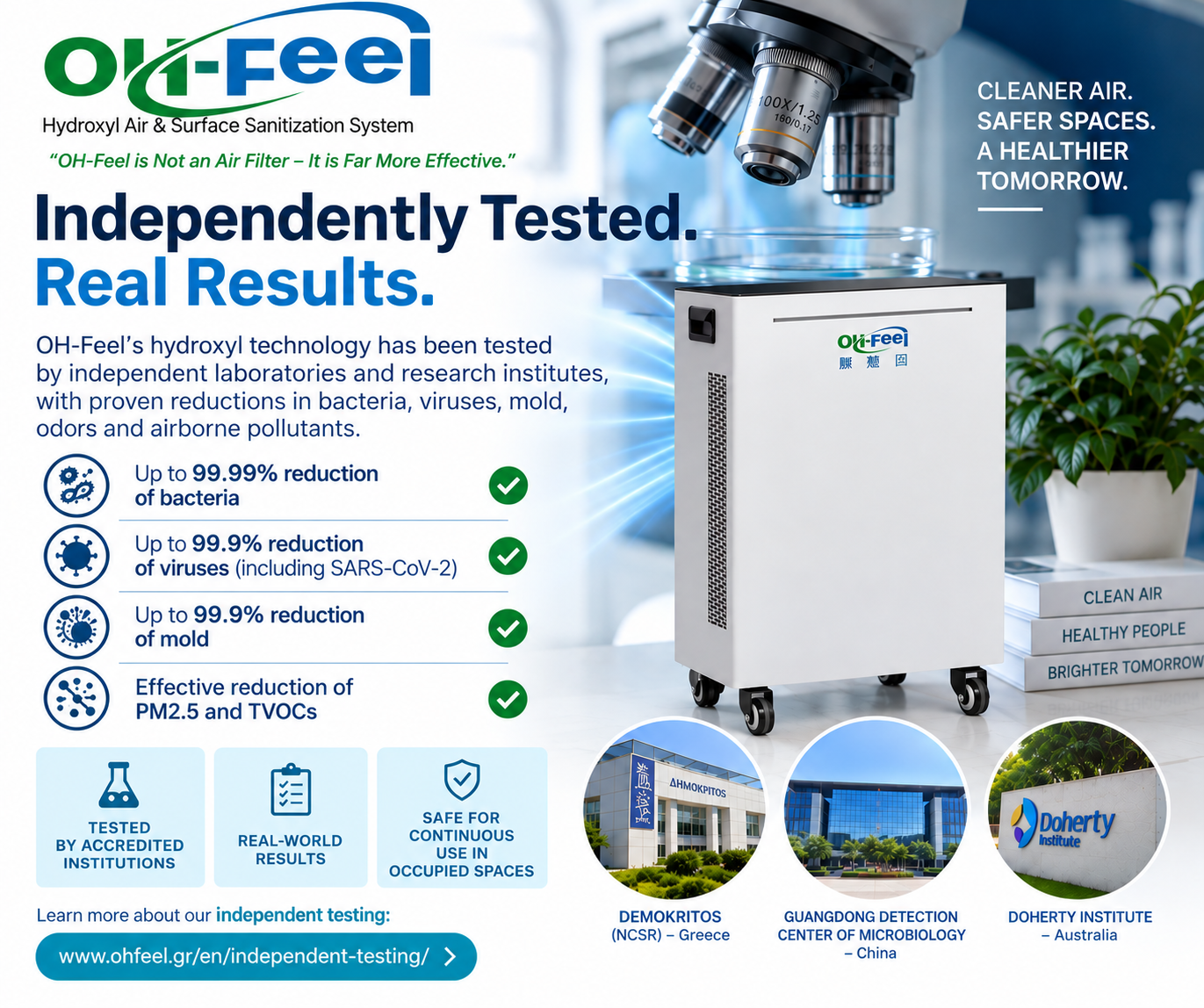
What Does “Independently Tested” Actually Mean?
Independent testing means that performance is evaluated by an outside laboratory, research institution or testing organization rather than relying solely on testing conducted, or claims made, by the manufacturer itself.
This distinction is important.
A manufacturer naturally understands its own technology, but independent testing provides additional evidence by examining specific aspects of performance under defined test conditions.
For OH-Feel technology, independent testing has examined areas including:
- bacteria and viruses
- mold
- volatile organic compounds (TVOCs)
- formaldehyde and other pollutant gases
- particulate matter
- clean air delivery performance
- ozone emissions
- UV leakage and other safety considerations
Some independent laboratory tests have demonstrated reductions of up to 99.99% for certain tested microorganisms and contaminants under the specific conditions of those tests.
Not every test examines every contaminant, and results vary according to what was tested and the conditions of the individual study. This is why it is important to look at the body of independent evidence, rather than relying on a single test or a single headline number.
Independent Testing of Bacteria and Viruses
Microorganisms are an important area of evaluation for any technology intended to help improve indoor environments.
OH-Feel hydroxyl technology has undergone independent testing involving a range of bacteria and viruses.
Testing conducted through the Doherty Institute in Australia examined microorganisms including Staphylococcus aureus, Pseudomonas aeruginosa, Escherichia coli and Staphylococcus albus, as well as viruses including HCoV-229E, H1N1 and HSV-1.
Independent laboratory testing has demonstrated reductions reaching up to 99.99% for certain tested microorganisms under defined test conditions.
These controlled tests provide evidence of the technology’s ability to reduce selected microorganisms under the specific conditions of the studies.
This is particularly relevant because OH-Feel technology is designed not simply to pull air through a filter, but to generate hydroxyl radicals (•OH) that disperse into the surrounding environment, treating the air and exposed surfaces.
Testing Beyond Microorganisms
Indoor air quality involves much more than bacteria and viruses.
Our indoor environments can contain particulate matter, volatile organic compounds, odors and pollutant gases originating from furnishings, cleaning products, cooking, smoking, building materials and everyday activities.
Independent testing of OH-Feel technology has therefore also examined other aspects of indoor air treatment.
Testing performed by the Guangdong Detection Center of Microbiology has included evaluations involving formaldehyde, benzene and TVOCs, as well as clean air delivery performance.
Additional independent testing has examined particulate matter, including PM10.
This broader range of testing is important because real indoor environments can contain a mixture of contaminants rather than a single isolated problem.
Safety Testing Matters Too
Effectiveness is only one side of the equation.
If an air-treatment technology is intended to operate continuously in occupied spaces, safety is equally important.
One area that deserves particular attention is ozone.
Some air-treatment technologies intentionally generate ozone. Others may produce small amounts as a by-product of their operation.
OH-Feel technology is designed for operation in occupied environments, so ozone emissions have been independently evaluated.
Testing conducted by Demokritos, Greece’s National Centre for Scientific Research, measured ozone from an OH-Feel 500-series unit operating at full power in an 18 m² test environment at 29 parts per billion (ppb).
For comparison, the U.S. Food and Drug Administration (FDA) sets a maximum acceptable ozone concentration of 0.05 ppm (50 ppb) for devices covered by its ozone regulation in enclosed spaces intended to be occupied for extended periods, including houses, apartments, hospitals and offices.
The U.S. Occupational Safety and Health Administration (OSHA) sets an occupational exposure limit for ozone of 0.10 ppm (100 ppb) as an 8-hour time-weighted average.
The independently measured 29 ppb result for the OH-Feel 500-series unit was therefore below both of these reference levels.
Testing has also addressed other safety considerations, including UV leakage.
For customers, these measurements are important because statements about suitability for occupied spaces should be supported by evidence rather than simply used as marketing language.
Laboratory Testing and Real-World Use Are Different
Independent laboratory testing provides valuable evidence, but it is also important to understand what it does — and does not — tell us.
Laboratory testing takes place under controlled conditions. A real home, office, medical facility, hotel, vehicle or yacht is not a laboratory.
Room size, ventilation, humidity, airflow, contaminant sources and operating time can all influence real-world performance.
For that reason, a particular laboratory result should not be interpreted as a guarantee that exactly the same percentage reduction will occur in every environment.
That does not diminish the importance of the laboratory results. Instead, independent testing helps answer a fundamental question:
Does the technology demonstrate measurable performance when evaluated under controlled conditions?
For OH-Feel, that evidence forms an important foundation for how we represent the technology.
More Than Odor Removal
Odor removal is one of the easiest effects of hydroxyl technology for a customer to notice.
A room, vehicle or boat cabin either smells better or it doesn’t.
But OH-Feel was not developed simply as an odor-removal product.
The same hydroxyl technology used to help break down odor-causing compounds has been independently evaluated across a much broader range of indoor environmental concerns.
That includes microorganisms, particulate matter, TVOCs and other pollutants, alongside safety evaluations such as ozone emissions and UV leakage.
This is why we describe OH-Feel as an air and surface sanitization system, rather than simply an air freshener or odor-removal machine.
Why Independent Evidence Matters to Us
Customers should be able to ask questions about the technology they bring into their homes, businesses, vehicles, boats and shared indoor environments.
Who tested it?
What was tested?
Under what conditions?
What results were achieved?
Was safety evaluated as well as effectiveness?
Those are reasonable questions.
OH-Feel does not rely solely on what the manufacturer says its technology can do. Independent testing provides measurable evidence that can be examined alongside real-world applications and experience.
Results reaching up to 99.99% reduction in certain independent laboratory tests are significant evidence of what hydroxyl technology can achieve under the tested conditions. At the same time, the broader collection of testing — covering microorganisms, pollutants, particulate matter and safety — provides a more complete picture of the technology than any single result alone.
No single laboratory test tells the entire story.
But when evaluating a technology designed to operate around people and continuously treat the indoor environment, independent evidence is an important place to start.
Claims are easy. Independent testing matters.
Learn more about the independent testing and validation behind OH-Feel:
