


How to Remove Persistent Yacht Odors with Hydroxyl Technology
Yacht odor removal can be difficult because odors often remain in cabin materials and on surfaces. Hydroxyl technology can help treat persistent odors in both the air and on exposed surfaces.
Why Yacht Odor Removal Can Be Difficult

Persistent odors are a common problem aboard yachts and boats. Cabins are enclosed spaces with limited ventilation, high humidity and many materials that can absorb and retain odors.
Typical sources include:
- Mold and mildew caused by moisture and condensation
- Sewage and holding-tank odors
- Fuel and diesel odors
- Cooking and food odors
- Cigarette and tobacco smoke
- Damp carpets, upholstery, mattresses and fabrics
- Odors that develop while a yacht is closed for extended periods
The difficulty is that these odors do not necessarily remain only in the air. Odor-causing compounds can penetrate curtains, carpets, upholstery, mattresses, wood and other porous materials.
This is why simply opening the yacht and ventilating it may temporarily improve the smell, only for the odor to return after the yacht is closed again.
Why Air Fresheners and Filtration May Not Solve the Problem
Air fresheners and fragrances can make a cabin smell better temporarily, but they generally mask an odor rather than address the compounds causing it.
Conventional air purifiers can be useful for capturing airborne particles, particularly when equipped with HEPA and activated-carbon filtration. However, air must pass through the purifier before it can be treated.
This becomes particularly important aboard a yacht because contamination and odor compounds may also be present on exposed surfaces and within porous materials.
For persistent yacht odors, treating only the air may therefore be insufficient.
How Hydroxyl Technology Works
Hydroxyl radicals (•OH) occur naturally in the outdoor atmosphere and play an important role in breaking down pollutants and organic compounds.
OH-Feel hydroxyl generators are designed to reproduce this oxidative chemistry indoors. The generated hydroxyls circulate with the surrounding air rather than requiring contaminants to first pass through a filter.
This allows hydroxyl technology to work throughout the treated space, including contact with exposed surfaces.
Rather than covering an unwanted smell with another fragrance, hydroxyls react with many odor-causing organic compounds and help break them down into simpler compounds.
Treating the Air and Exposed Surfaces 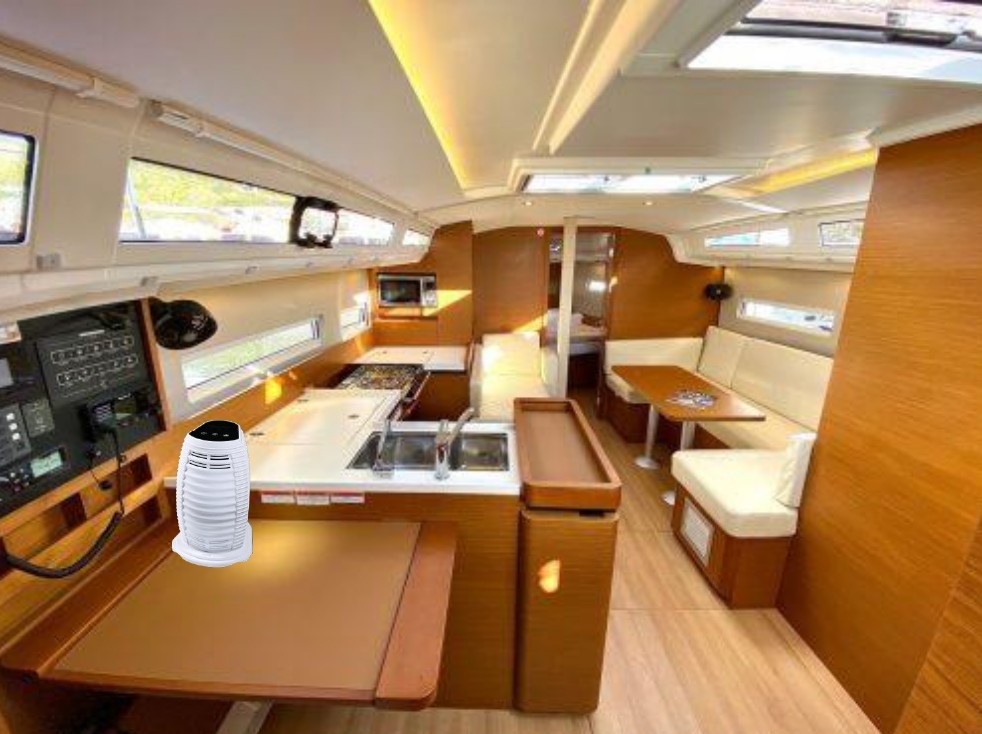
This distinction is particularly useful in marine environments.
A musty smell may originate from a damp carpet, mattress, curtain, upholstery or another surface. Cigarette smoke compounds can similarly remain in fabrics and cabin materials long after smoking has stopped.
A filtration system primarily treats the air drawn through the machine. Hydroxyls, by contrast, are dispersed into the occupied environment, allowing them to interact with contaminants in the air and on accessible surfaces.
This does not eliminate the need to correct the underlying source of a problem. Water leaks, active mold growth, sewage-system problems or fuel leaks should always be identified and repaired.
Hydroxyl treatment is intended to address the resulting airborne and surface contamination and persistent odors — not substitute for necessary maintenance or cleaning.
OH-Feel Yacht Odor Treatment in Greece
OH-Feel has used hydroxyl technology aboard yachts in Greece with persistent odor problems, including vessels affected by strong musty and sewage-type odors.
Our marine treatment process generally begins with a more intensive treatment using a higher-capacity OH-Feel hydroxyl generator. Depending on the vessel and severity of the problem, treatment may continue for several days.
For yachts susceptible to recurring odors, a smaller OH-Feel unit can then operate continuously to help maintain the cabin environment, particularly while the yacht is closed and unoccupied for extended periods.
Our yacht case studies have included vessels at Alimos Marina and Almira Shipyard, where persistent cabin odors were successfully neutralized following hydroxyl treatment.
Hydroxyl Treatment vs. Ozone
Ozone generators have historically been used for severe odor remediation, but high-concentration ozone treatment requires important safety precautions and normally requires the treated area to be unoccupied.
OH-Feel’s approach is different.
Our hydroxyl systems are designed for continuous operation in occupied environments when used according to their operating instructions. OH-Feel equipment has also undergone independent testing for ozone emissions and other safety parameters.
This makes hydroxyl technology particularly suitable for applications where continuous treatment is desirable rather than periodically evacuating a vessel for high-concentration ozone treatment.
When Hydroxyl Treatment Can Help
Hydroxyl technology may be useful for yachts experiencing:
- Persistent musty or damp odors
- Mold and mildew-related odors after the moisture source has been addressed
- Sewage and holding-tank odors after mechanical problems have been corrected
- Cigarette and tobacco odors
- Cooking and food odors
- General stale cabin odors after long periods closed
- Fuel-related residual odors after the source has been identified and corrected
The objective is not simply to make the yacht smell more pleasant. It is to address odor-causing compounds rather than masking them with fragrances.
Preventing Odors From Returning
For charter fleets and privately owned yachts, prevention can be particularly valuable.
A yacht may smell fresh immediately after cleaning but develop musty or stale odors again after remaining closed for several days or weeks.
Continuous low-energy hydroxyl treatment can help maintain the interior environment between uses and reduce the opportunity for persistent odors to become established again.
Learn More About OH-Feel Marine Solutions
OH-Feel provides hydroxyl air and surface treatment systems for yachts, boats and other marine environments throughout Greece.
Read our yacht hydroxyl case study to see examples of vessels treated in Greece and the results observed.
For advice about the appropriate OH-Feel system for a particular yacht or cabin area:
Email: info@ohfeel.gr
Tel: +30 693 275 6720
Website: www.ohfeel.gr
