


Your Office May Look Clean—But What Is Still in the Air?
A freshly cleaned office can look spotless. Desks are wiped, floors are vacuumed and waste bins are emptied. However, visible cleanliness does not necessarily mean that the indoor air is clean.
Employees and visitors spend many hours breathing the same shared air. When windows remain closed during winter, pollutants from both indoor and outdoor sources can accumulate or continue circulating throughout the workplace.
Good office indoor air quality therefore requires attention to more than the surfaces we can see.
What can remain in office air?
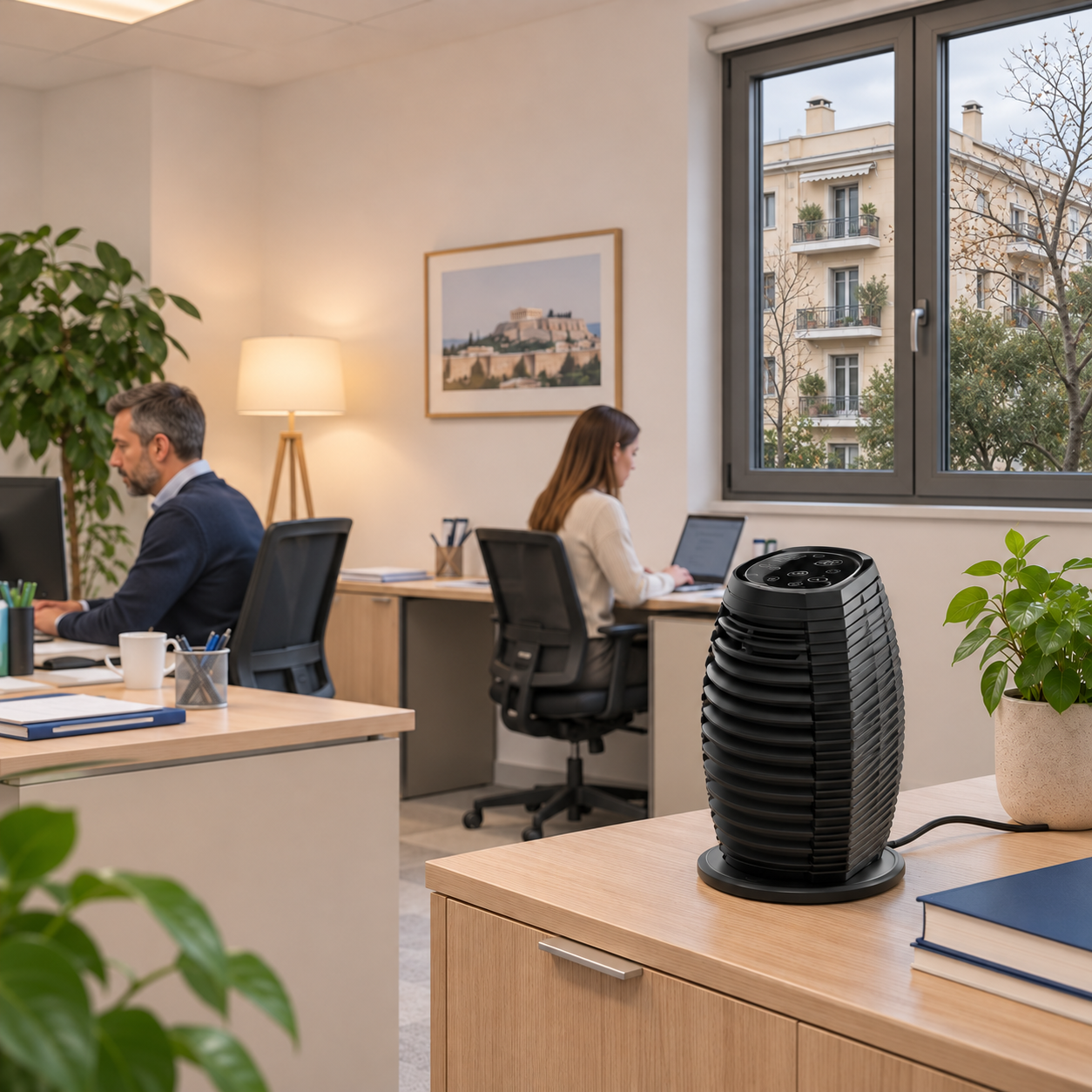
The air inside an office may contain a mixture of particles, biological contaminants and chemicals, including:
- Fine particulate matter such as PM2.5
- Dust and pollen
- Mold spores
- Bacteria and viruses
- Allergens
- Volatile organic compounds, commonly called VOCs or TVOCs
- Odors from food, cleaning products, furnishings or tobacco smoke
Some contaminants enter from outside through doors, windows and ventilation systems. Others originate indoors from printers, furniture, floor coverings, cleaning products, damp materials and normal human activity.
Moisture also matters. Condensation, leaks or poorly maintained air-conditioning systems can create conditions that support mold and other biological contamination.
Why normal cleaning is not enough
Normal cleaning remains essential. Dust, dirt, spills and visible contamination should always be physically removed, while moisture problems and sources of mold must be corrected.
However, routine cleaning mainly addresses accessible surfaces. It does not continuously treat everything suspended in the air or contamination that settles again after cleaning has finished.
Ventilation is also important because it brings in outdoor air and helps dilute indoor pollutants. Nevertheless, opening windows may not always be practical because of cold weather, noise, security, outdoor pollution or the operation of heating and air-conditioning systems.
This is why indoor air quality should be approached as an ongoing process rather than an occasional cleaning task.
What about conventional air filters?
Air filters can be useful, particularly for capturing particles. Their limitation is that they can treat only the air that reaches the machine and passes through the filter.
Contaminants elsewhere in the room, including those deposited on desks, chairs, door handles and other exposed surfaces, do not pass through an air filter.
OH‑Feel works differently.
Active treatment throughout the occupied space
OH‑Feel systems use ultraviolet technology to generate hydroxyl radicals. These highly reactive molecules are also produced naturally in the outdoor atmosphere.
The hydroxyls travel with the room’s airflow instead of waiting for contaminants to enter a filter. This allows the treatment to extend throughout the occupied space, helping reduce contaminants in the air and on exposed surfaces.
OH‑Feel systems are designed for continuous operation around people, pets and plants. This makes the technology suitable for offices, meeting rooms, reception areas and other shared workplaces.
Independent testing of OH‑Feel technology has examined its performance against particulate matter, volatile organic compounds and a range of biological contaminants. Details are available in the Test Results section of the OH‑Feel website.
Helping reduce cross-contamination during winter
Winter usually brings an increase in colds, influenza and other respiratory infections. In shared offices, microorganisms can spread when people breathe, speak, cough or sneeze, as well as through hands and frequently touched surfaces.
Because OH‑Feel continuously treats the air and exposed surfaces, it can help reduce environmental microbial contamination and therefore help reduce the risk of cross-contamination between people and different parts of the workplace.
OH‑Feel technology has been independently tested against H1N1 influenza and a range of other viruses and microorganisms.
The system should be used as part of a combined approach that also includes ventilation, regular cleaning, hand hygiene and sensible workplace policies when employees are unwell. It does not guarantee that illness will be prevented or replace these important measures.
Choosing an OH‑Feel unit for an office
The appropriate unit depends on the size, layout and use of the space.
For an individual office, small reception area or meeting room of up to approximately 30 m², the compact FC08A can provide continuous treatment while consuming only 10 watts of electricity. It operates quietly and has two fan speeds.
Larger open-plan offices or shared areas may require a larger OH‑Feel model or more than one unit to achieve suitable distribution throughout the space.
Room size is only one consideration. Closed doors, partitions, occupancy levels and the position of the unit also affect how air moves through the workplace.
Part of a complete indoor-air strategy
OH‑Feel does not replace good building management. A sensible office indoor-air-quality plan should include:
- Regular physical cleaning
- Adequate ventilation
- Proper air-conditioning maintenance
- Prompt correction of leaks and dampness
- Control of pollutant sources
- Continuous air and exposed-surface treatment where appropriate
The objective is not to make an office smell perfumed or simply appear clean. It is to address the indoor environment more completely.
Your office may already look clean. The next question is: what are employees and visitors breathing throughout the working day?
To learn more about OH‑Feel solutions for offices and shared spaces, visit www.ohfeel.gr or contact us for help selecting the appropriate system.
